- All
- Product Name
- Product Keyword
- Product Model
- Product Summary
- Product Description
- Multi Field Search


Views: 7 Author: Site Editor Publish Time: 2025-11-07 Origin: Site


Ironmaking wastewater is a collective term for blast furnace gas washing water and slag flushing wastewater, representing a large volume and distinctive characteristic of industrial wastewater generated during steel production. It primarily originates from the blast furnace gas washing and slag cooling processes in the ironmaking workshop. This type of wastewater not only has a high temperature but is also characterized by a high concentration of suspended solids, especially iron oxides.
Although most pollutants can be removed through conventional physical and chemical methods, indicators such as manganese, iron, some organic matter, and turbidity in the wastewater may still exceed standards, preventing it from meeting reuse criteria. This not only wastes water resources but also poses potential environmental risks. Therefore, achieving a high proportion of wastewater reuse hinges on deep dewatering of the separated sludge. Through efficient solid-liquid separation, filter presses can effectively intercept and concentrate residual fine particles and pollutants in the water, ensuring that the separated clear water can be safely and stably reused in the production system, significantly improving the wastewater reuse rate.
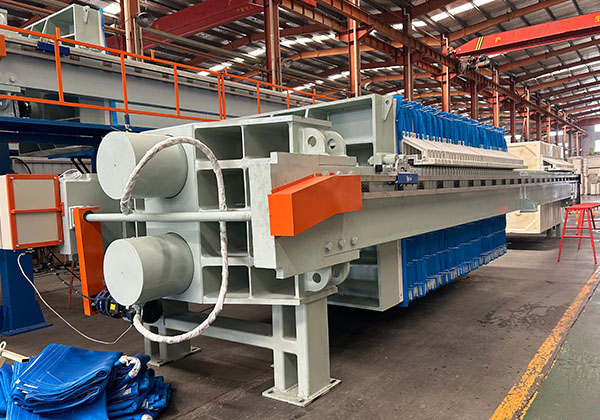
This type of filter press is the most common in industrial applications, renowned for its wide applicability and stable dewatering effect. They can flexibly handle industrial sludge of various properties, including high-suspended-solid sludge from metallurgical wastewater. Automatic chamber filter press can withstand high pressure, have high dewatering efficiency, low filter cake moisture content, and are easy to operate and maintain. The technology is mature and reliable, making them ideal for large-scale treatment of ironmaking wastewater.
When companies have higher requirements for filter cake thickness, or the sludge is compressible, we strongly recommend upgrading to an automatic membrane filter press. Based on traditional dewatering, it adds a secondary squeezing function, using high-pressure gas or liquid to squeeze the filter plates through a diaphragm, further reducing the filter cake moisture content and achieving more thorough solid-liquid separation. Additional functions such as filter cloth washing systems and belt conveyors can also be equipped to improve production efficiency.
In summary, by introducing efficient filter press technology, ironmaking wastewater treatment systems can significantly improve water quality and achieve a high proportion of wastewater reuse, thereby reducing production costs and contributing to the sustainable development of enterprises. Contact Quanhong Filtration to choose the filtration solution that suits your needs.