- All
- Product Name
- Product Keyword
- Product Model
- Product Summary
- Product Description
- Multi Field Search


Views: 6 Author: Site Editor Publish Time: 2026-05-18 Origin: Site


As global environmental protection requirements become increasingly stringent, the sustainable development of the chemical fiber industry faces significant challenges. Throughout the chemical fiber production process—from polymerization to spinning—each stage generates substantial volumes of industrial wastewater. Achieving efficient solid-liquid separation is not only crucial for ensuring corporate compliance with environmental regulations but also directly impacts production costs.
During the production of chemical fibers—such as polyester, nylon, and viscose—large quantities of high-concentration industrial wastewater are discharged. This wastewater typically contains suspended solids, oils, dye residues, organic compounds, and various chemical auxiliaries; it is characterized by high pollutant concentrations, complex chemical compositions, and inherent difficulty in treatment. If discharged directly without effective treatment, it not only pollutes surface water bodies but can also lead to long-term contamination of soil and groundwater. Consequently, chemical fiber wastewater treatment has become a critical process that chemical fiber enterprises must prioritize.
In the final stages of wastewater treatment, the sludge resulting from chemical flocculation and sedimentation typically possesses an extremely high moisture content. Filter presses utilize high pressure to force the solid-liquid separation of this moisture-laden chemical sludge. Following the filtration process, suspended solids from the wastewater are retained within the filter chambers to form a filter cake, while the clarified liquid passes through the filter cloth for discharge—thereby enabling water recycling or compliant effluent discharge. The retained chemical fiber sludge is compressed into dry filter cakes, facilitating their centralized transport or subsequent incineration.
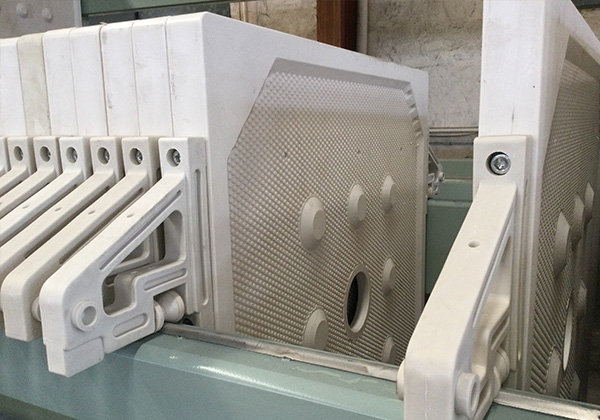
Given the high viscosity and inherent filtration difficulty associated with chemical fiber sludge, the automatic chamber filter press stands out as the most suitable equipment choice. Its advantages are primarily demonstrated in the following key areas:
Robust Structure and High Pressure Resistance: The chamber-style design allows the unit to withstand higher filtration pressures, resulting in filter cakes with lower moisture content and, consequently, reduced downstream transportation costs.
Large Filtration Area:Despite its compact structural footprint, the equipment offers a significantly larger filtration surface area within the same floor space, thereby substantially boosting processing efficiency per filtration cycle.
High Degree of Automation: The system can be equipped with automated plate-shifting and filter cloth washing system, effectively reducing manual labor intensity and making it ideally suited for the large-scale, continuous operations typical of export-oriented manufacturing facilities.
Corrosion-Resistant Components: The filter plates are constructed from reinforced polypropylene (PP), enabling them to easily withstand the acidic and alkaline substances often present in chemical fiber wastewater.
As an experienced supplier of filter presses, Quanhong Filtration recommends that chemical fiber enterprises select customized, automated chamber filter presses based on their specific daily processing volume. High-quality filtration machine not only assists companies in fulfilling their environmental responsibilities but also generates long-term value through resource recovery. If you are seeking solutions to enhance your wastewater treatment efficiency, we invite you to contact our engineers to receive a detailed filter press selection guide and a quotation.